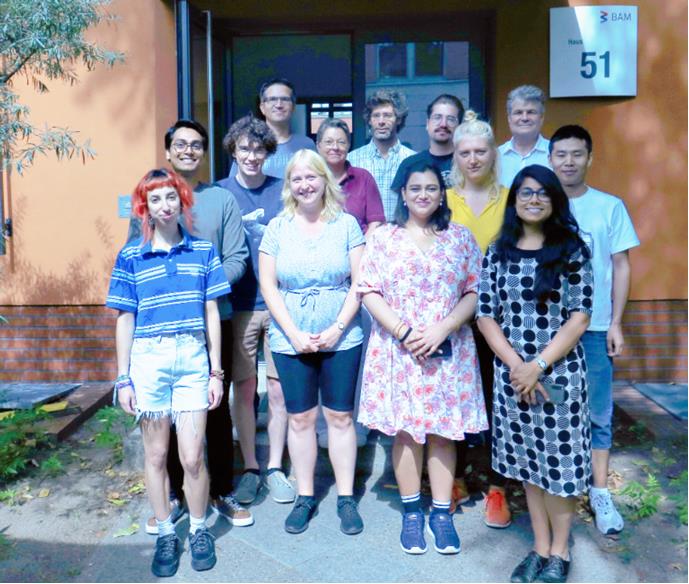
Our research focuses on the ecology and evolution of host-parasites. Using insects as study systems, we are interested in the diverse selection pressures that act on and between closely associated organisms, particularly the interplay between hosts and pathogens in complex insect societies.
Current research topics include the evolution of virulence and emergence of infectious viruses in animals (with a focus on insects); the evolution and ecology of social immunity in termites; and the interaction between diet, microbiota and immunity in cockroaches.
We are part of the Freie Universität Berlin, and our labs are situated in the BAM (Bundesanstalt für Materialforschung und prüfung).
We are members of the Centre of Infection Biology and Immunity (ZIBI) and the Biodiversity Institute – Berlin-Brandenburg Institute of Advanced Biodiversity Research (BBIB). We collaborate with the Berlin Center for Genomics in Biodiversity Research (BeGenDiv) and the core facility for biomacromolecular analysis BioSupraMol.
 orcid.org/0000-0003-1119-5299
People

Mara Julseth
PhD student
I am a PhD Student in evolution and ecology, with a background in social immunity, neurobiology, philosophy, and anthropology. In my current project I look at termite chromosome evolution across native European Reticulitermes species. Combing field work collection from Italy to Spain with modern sequencing technologies and karyotyping, I aim to relate different chromosomal arrangements to inbreeding and inter/intra-species evolution, thereby looking at the involvement of chromosomal re-arrangements on two evolutionary scales. This project is part of the DFG funded SPP “Gevol”, which looks at the genomic basis of evolutionary innovations across a multitude of organisms.

Özge Kiliç
PhD student
I am PhD student in termite social behaviour. My background lies in Molecular Biology and Genetic, Bioinformatic and Biotechnology. In my master I mainly worked in industrial biotechnology and focused on simulating molecular mechanisms. Currently, I am working on to build an automated system to track the behaviour of the Eastern subterranean termite Reticulitermes flavipes. My aim is to explore the molecular mechanism underlying their social interactions. I am using different kind of machine learning software and programming languages to analyse their behaviours in different conditions. I will use a range of biotechnological and molecular techniques to understand molecular mechanisms of their behaviours.

Cedric Aumont
PhD student
I am a PhD student in Evolutionnary Ecology focusing on the emergence of eusociality in Blattodea, the family including cockroaches and termites. My background lies in functional, behavioural, and evolutionary ecology, and in life sciences engineering. To investigate how termites became social cockroaches, I am analysing genomes of different species of termites and cockroaches focusing on the diversity of their immune gene families. Additionally, I am analysing caste-specific gene co-expression networks from brain tissue in 15 species of Blattodea. For my PhD project, I am collaborating with several universities across the world including the University of Münster, the Okinawan Institute of Science and Technology, the Czech University of Life Sciences, the Federal University of ABC and the Ohio State University.

Harshit Prajapati
PhD student
I am a Ph.D. student from India with a background in Biotechnology and Bioinformatics. My project work ‘buzzes’ around honeybees – a great insect species of high environmental and economic value. Being one of the most important pollinators comes with various disadvantages for honeybees. They are often infected with several viruses, especially since the spread of a vectoring parasitic mite – Varroa destructor. In the hives infested with the mites, replication of specifically one virus is often found to be amplified – Deformed Wing Virus (DWV). In this MSCA funded ITN:VIROINF project, I am studying the evolution of DWV in honeybees (Apis mellifera), under the supervision of Prof. Dino McMahon. In our labs at the Bundesanstalt für Materialforschung und -prüfung (BAM), I am investigating the role of transmission and recombination on the adaptation of viral virulence, and how these changes in virulence, during experimental evolution, affect host immune responses. My work majorly involves virus identification and passaging (in honeybees), while also utilizing long-read sequencing to reconstruct viral quasi-species for further analyses.

Shixiong Jiang
PhD student
My research interests include neuropeptidomes and host-pathogen interactions in Blattodea. Specifically, comparative analysis of neuropeptides across major termite lineages, including solitary cockroaches and subsocial wood roaches, focusing particularly on adipokinetic hormones (AKH) and their receptors (AKHR). In addition, using Blattella germanica as a model host, I am interested in the role of AKH peptides in mediating immunity, by co-injecting peptides together with the Gram-negative bacteria Pseudomonas entomophila, I would examine how carbohydrates and lipids are mobilised in the hemolymph, and how its impacts survival, etc. Furthermore, I am interested in a fresh perspective on the feasibility of using AKHs as potential candidates for biorational pest control agents against invasive termites and cockroaches.

Srijita Ray
PhD student
I am interested in the relationship between insect and their gut microbiota. My PhD project is focusing on the obligate endosymbiont Blattabacterium of the German cockroach Blattella germanica, a bacterium involved in the degradation of uric acid for nitrogen assimilation. In the lab, I am working on sterile and conventionally reared cockroaches in order to use them in evolution experiment..

Luiza Da Silva
Visiting PhD student
I am a PhD student from the Federal University of ABC, Sao Paulo, Brazil and I am visiting the McMahon’s lab for 10 months as part of my PhD project. I have been developing my research in the field of termite biology, mainly in the behavioural, reproductive, developmental and morphological areas. During my PhD, I am studying the different strategies used by neotropical termites to prevent fungal infection to spread in the colony. More specifically, I am studying the individual and collective responses of the soldierless termite Anoplotermes pacificus against nestmates infected by the entomopathogenic fungus Metharizium robertsii. During my visit to BAM, I am working on the differential expression of genes in termites at different stages of fungal infection to obtain information on the insect’s innate responses and their development throughout the infection process, as well as to contribute to a comprehensive understanding of the immune adaptations of this species when facing microbial threats.
 McMahon Lab